Adrenal Insufficiency 101
Introduction
Disclaimer: Information found here should be taken as medical advice. It is information curated and organized by Adrenal Insufficiency United with oversight from our Medical Advisory Board for accuracy. It is to be used to discuss with your medical team. Each person with adrenal insufficiency is unique and what works or is true for one person may be different for another.
Adrenal insufficiency (AI) happens when your adrenal glands (small glands that sit on top of your kidneys) do not make enough hormones. One of the most important of these hormones is cortisol.
Cortisol helps almost every part of your body work the way it should. Many people call cortisol the “stress hormone,” but it does much more than help your body handle stress.
Cortisol helps your body:
- Control inflammation (your body’s response to illness, injury, and infection)
- Turn food into energy (metabolism)
- Digest food
- Keep your blood pressure steady
- Help your immune system work properly
- Keep your blood sugar at healthy levels
- Sleep well
- Keep your body at a normal temperature
Depending on the type of adrenal insufficiency you have, your body may also not make enough aldosterone or androgens.
Aldosterone
Aldosterone helps your kidneys keep the right amount of salt (sodium) and water in your body while getting rid of extra potassium. This helps keep your blood pressure, hydration, and electrolytes balanced.
Androgens
Androgens are hormones that help with muscle strength, hair growth, sex drive, mood, and some parts of growth and reproduction.
Adrenal insufficiency has multiple causes and is divided into three main types: primary, secondary, and tertiary—depending on where the problem starts in your body.
Primary* The cause starts in the adrenal glands.
Causes may include:
- Autoimmune disease (the body’s immune system attacks the adrenal glands)
- Genetic Disorders
- Surgical removal of the adrenal glands
- Bleeding into the adrenal glands
- Infections
- Some medications
*Primary Adrenal Insufficiency is often called Addison’s. However while anyone with Addison’s is primary there are other causes of primary adrenal insufficiency that are not Addison’s
Secondary: The pituitary gland does not send the right signal to the adrenal glands. The signal is a hormone called ACTH. Without enough ACTH, the adrenal glands do not make enough cortisol,
Causes may include:
- Pituitary tumors
- Brain surgery or irradiation that damages the pituitary gland
- Bleeding into the pituitary gland
- Inflammatory and autoimmune disease
- Traumatic brain injury
- Genetic disorders
Tertiary: The hypothalamus does not send the signal that tells the pituitary gland to make ACTH. This signal is a hormone called CRH.
Causes may include:
- Long-term corticosteroid usage (most common cause)
- After Cushing’s syndrome is cured
- Use of long-term high-dose opioid pain medications, such as Oxycodone
An adrenal crisis is a medical emergency. It needs immediate treatment with emergency steroid medicine and emergency medical care. Waiting too long to get treatment can be life-threatening.
Warning signs may include:
- Vomiting and not being able to keep your medicine down
- Severe diarrhea with weakness or dehydration
- Severe stomach pain
- A very fast heartbeat
- Extreme weakness or collapsing
- Confusion or trouble thinking clearly
- Fainting or passing out
- Feeling so dizzy that you cannot stand
- Feeling very cold or shaking with chills
- Signs of shock, such as very low blood pressure or cold, clammy skin
- A high fever
If you think you or someone else is having an adrenal crisis:
- Give the emergency steroid injection if it is available and has been prescribed.
- Call 911 or go to the nearest emergency department immediately.
- Do not wait to see if the symptoms get better.
Learn more about how to prepare for Adrenal Emergencies HERE
When people hear the word stress, they often think about worry or anxiety. With adrenal insufficiency, stress can mean anything that causes the body to need more cortisol than usual.
This can include things such as illness, fever, injury, surgery, or other physical stress on the body.
In a person without adrenal insufficiency, the adrenal glands automatically make more cortisol when the body is under stress. This extra cortisol helps the body:
- Maintain blood pressure
- Maintain blood sugar
- Respond to illness and inflammation
- Have enough energy to handle the added stress
People with adrenal insufficiency may not be able to make the extra cortisol their body needs. Instead, they need to take extra glucocorticoid medicine during certain types of stress. This is called stress dosing.
Stress dosing helps replace the extra cortisol that healthy adrenal glands would normally make.
When the illness or other stress has passed and the person is recovering, the glucocorticoid dose is usually lowered back to the person’s normal daily dose. Follow the stress-dosing plan provided by your healthcare provider.
Physical and Emotional Stressors
While physical stressors are the most common reason for increasing glucocorticoid replacement, major emotional trauma can also place significant physiological demands on the body.
Examples of Physical Stress: Not all are listed
- Fever
- Viral illnesses, such as the flu
- Bacterial infections
- Vomiting or diarrhea
- Significant injuries
- Surgery or other medical procedures
- Some dental procedures
- Major burns
- Childbirth
Vomiting and diarrhea need special attention. If a person cannot keep glucocorticoid medicine down or cannot absorb it because of repeated vomiting or severe diarrhea, an emergency glucocorticoid injection may be needed. Follow your healthcare provider’s emergency plan.
Examples of Severe emotional stress: not all included
- Death of a loved one
- A serious or traumatic event
- A major crisis involving yourself or someone close to you
- Other severe emotional trauma
Not every stressful situation requires extra glucocorticoid medicine. Talk with your healthcare provider about when emotional or physical stress should be treated with stress dosing and make sure you have a written plan to follow.
During a major emotional event, it is important to pay attention to how you feel physically as well as emotionally.
Watch for symptoms such as:
- Increased tiredness
- Dizziness
- Nausea
- Weakness
- Loss of appetite
- Other signs that you may not have enough cortisol
If symptoms develop or get worse, follow your personal stress-dosing plan and contact your healthcare provider as needed. Signs of an adrenal crisis require emergency treatment.
Medications
This section explains the medicines commonly used to treat adrenal insufficiency (AI). It includes common medicines, usual dose ranges, medicine comparisons, and general treatment guidelines for adults.
Always talk with your healthcare provider before changing your medicine or your dose.
One of the most important parts of treating adrenal insufficiency is finding the right amount of cortisol replacement medicine.
- Too little medicine can leave your body without enough cortisol to work properly.
- Too much medicine can also cause health problems over time, including symptoms similar to Cushing’s syndrome.
Your healthcare provider will choose a starting dose based on medical guidelines and factors such as your body size. Over time, your dose may need to be adjusted based on your symptoms, how you feel, and your overall health.
Everyone with adrenal insufficiency is different. The right dose for one person may not be right for another.
Some symptoms of too little medicine and too much medicine can be similar. Other health conditions can also cause similar symptoms, so it is important to work closely with your healthcare provider.
You may notice a temporary boost in energy if your glucocorticoid (steroid) dose is too high. This does not mean the dose is right. Changes to your medicine should be based on how you feel over time, not just on short-term changes.
Primary Adrenal Insfuficiency (PAI)
The Endocrine Society provides guidelines for treating adults with Primary Adrenal Insufficiency (PAI). These are general recommendations. Each person may need a different dose based on their individual needs.
Different recommendations are used for children and during pregnancy.
Glucocorticoid Replacement
Glucocorticoids replace the cortisol the body cannot make.
For adults, the Endocrine Society recommends:
- Hydrocortisone: 15–25 mg each day, usually split into 2 or 3 doses.
- Cortisone acetate: 20–35 mg each day, usually split into 2 or 3 doses.
- Prednisolone: 3–5 mg each day, taken once or twice a day. This may be used instead of hydrocortisone.
- Dexamethasone: This is generally not recommended for daily treatment of PAI. It can be difficult to adjust the dose and may increase the risk of getting too much steroid.
Mineralocorticoid Replacement
People with PAI may also need medicine to replace aldosterone, another hormone made by the adrenal glands.
The Endocrine Society recommends:
- Fludrocortisone: A common starting dose for adults is 0.05–0.1 mg (50–100 micrograms) each day.
- People taking fludrocortisone should not routinely limit salt unless their healthcare provider tells them to.
- If blood pressure becomes too high, the healthcare provider may lower the fludrocortisone dose.
- If blood pressure stays high, blood pressure medicine may be needed while continuing fludrocortisone.
DHEA Replacement
DHEA is a hormone made by the adrenal glands.
The Endocrine Society suggests that some women with PAI may try DHEA if they continue to have low energy, symptoms of depression, or low interest in sex even when their other adrenal replacement medicines have been adjusted.
- A trial of DHEA may last about 6 months.
- If it does not provide lasting benefits after 6 months, the Endocrine Society recommends stopping it.
- DHEA is sold as a dietary supplement in the United States and is not FDA-approved as a prescription drug for treating adrenal insufficiency.
Endocrine Society. Summary of Recommendations, 3.0 Treatment of primary adrenal insufficiency in adults, Glucocorticoid replacement regimen. Available at https://www.endocrine.org/clinical-practice-guidelines/primary-adrenal-insufficiency Accessed June 3, 2026.
Secondary Adrenal Insufficiency (SAI)
The Endocrine Society provides guidelines for treating adults with Secondary Adrenal Insufficiency (SAI). These are general recommendations. Each person may need a different dose based on their individual needs.
Different recommendations are used for children and during pregnancy.
Glucocorticoid Replacement
Glucocorticoids replace the cortisol the body cannot make.
For adults, the Endocrine Society recommends:
- Hydrocortisone: Usually 15–20 mg each day, taken once or split into more than one dose.
- When hydrocortisone is split into doses, the highest dose is usually taken in the morning.
- Some people may use a longer-acting steroid, such as prednisone or prednisolone, instead of hydrocortisone.
- The goal is to use the lowest dose that safely replaces the cortisol the body needs. Taking too much steroid over time can cause health problems.
Healthcare providers should watch for signs and symptoms of getting too little or too much steroid. Blood tests alone cannot tell if the daily glucocorticoid dose is right for a person.
Mineralocorticoid Replacement
People with SAI usually do not need fludrocortisone.
This is because the body can usually still make aldosterone, the hormone that helps control salt, fluid, and blood pressure.
DHEA Replacement
DHEA is a hormone made by the adrenal glands. People with SAI may make less DHEA.
Some women with SAI may have symptoms such as:
- Low energy
- Low interest in sex
- Lower quality of life
DHEA has been studied as a possible treatment for these symptoms, but it is not routinely recommended for everyone with SAI. A healthcare provider can help decide whether DHEA should be considered for an individual patient.
Other Hormones
SAI is often caused by a problem with the pituitary gland or the part of the brain that controls it. Because the pituitary helps control many hormones, some people with SAI may also need other hormone replacement.
Depending on the cause, these may include:
- Thyroid hormone
- Sex hormones
- Growth hormone
- Desmopressin (DDAVP) for diabetes insipidus
An Important Note About Thyroid Hormone
If a person has both adrenal insufficiency and low thyroid hormone levels, glucocorticoid treatment should be started before thyroid hormone treatment.
Starting thyroid hormone before treating adrenal insufficiency can increase the body’s need for cortisol and may trigger an adrenal crisis.
⁴ Endocrine Society. Summary of Recommendations, Hormonal Replacement in Hypopituitarism in Adults: An Endocrine Society Clinical Practice Guideline. Fleseriu M, et al. Journal of Clinical Endocrinology & Metabolism. 2016;101(11):3888-3921.
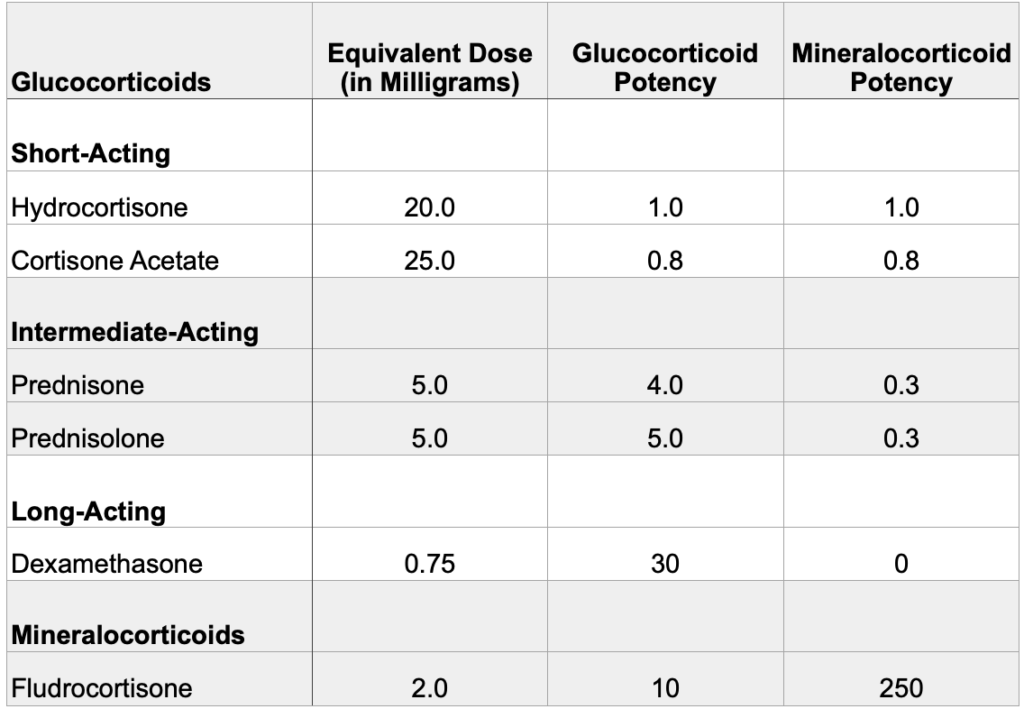
The table below shows medications to help manage adrenal insufficiency and how they compare with each other. Two medications may provide similar replacement at equivalent doses but can differ in duration of action, dosing schedules, and how individual patients experience them.
These equivalencies are approximate and do not mean medications can be switched without guidance from a healthcare provider. Different glucocorticoids vary in duration of action, mineralocorticoid activity, and how they are used clinically.
Glucocorticoid Equivalencies
Note: Medications listed in the table are typically available in the United States. Other countries may have additional options, such as Plenadren, which currently has “orphan status as a licensed treatment for adrenal insufficiency by the European Medicines Agency (EMA).
Another way to think about what is shown in the graph on the previous page, is in how they compare to hydrocortisone, which is the closest to the cortisol someone with adrenal insufficiency cannot make enough of:
Prednisone is about 4 times stronger than hydrocortisone.
Prednisolone is about 4–5 times stronger than hydrocortisone.
Dexamethasone is about 25–30 times stronger than hydrocortisone.
Cortisone acetate is slightly less potent than hydrocortisone.
National Library of Medicine. Table 1: Glucocorticoid Equivalencies. Available at https://www.ncbi.nlm.nih.gov/books/NBK279156/table/adrenal_glucocorticoid-therapy-and-adrenal-suppression.T./ Accessed June 3, 2026.
Types of Adrenal Insufficiency
Information compiled by AIU using sources from the Lancet 2014 “Adrenal Insufficiency”: Evangelia Charmandari, Nicolas C Nicolaides, George P Chrousos. Additional resources from NIH and Mayo Clinic were also used. Reviewed and edited by Dr. Mitchell Geffner.
Primary Adrenal Insufficiency
Secondary Adrenal Insufficiency
Tertiary Adrenal Insufficiency
Newly Diagnosed? You're Not Alone.
Frequently Asked Questions
What are the symptoms of Adrenal Insufficiency?
AI Symptoms
People with adrenal insufficiency can have many different symptoms. Not everyone has the same symptoms.
You may not have all of these symptoms. Some people have only a few, while others have many. Your symptoms may also change over time.
Many of these symptoms can look like the flu or other illnesses. Work with your healthcare provider to learn which symptoms are normal for you and which may need medical attention.
Physical Symptoms
- Extreme tiredness (fatigue)
- Feeling weak
- Feeling worn out after even small amounts of activity
- Trouble exercising or being active
- Muscle aches
- Joint pain or a feeling of "heavy" arms or legs
- Weight loss without trying
- Craving salty foods (more common in primary adrenal insufficiency)
- Less hair under the arms or around the genitals (primary adrenal insufficiency)
- Darkening of the skin (hyperpigmentation) in primary adrenal insufficiency, including:
- A bronze or darker skin color
- Darker skin in the creases of the hands
- Dark patches on the lips or inside the mouth
- Darker skin around scars or places where clothing or shoes rub
Thinking and Memory Symptoms
These symptoms affect how you think and remember things.
- Trouble concentrating
- Slower thinking
- Forgetfulness
- Brain fog or trouble thinking clearly
- Trouble with tasks that have many steps
Mood and Emotional Symptoms
These symptoms affect how you feel and respond to stress.
- Feeling irritable or easily annoyed
- Anxiety
- Feeling sad or depressed
- Crying more easily than usual
- Feeling overwhelmed by small problems
- Taking longer to recover from stress
- Not feeling like yourself
Heart, Blood Pressure, and Hydration Symptoms
These symptoms are often more common in primary adrenal insufficiency because the body may not make enough aldosterone.
- Dizziness
- Feeling lightheaded
- Fainting or feeling like you might faint
- Feeling dizzy when you stand up because your blood pressure drops
- Low blood pressure
- Feeling like your heart is racing, pounding, or fluttering (heart palpitations)
- Signs of dehydration, such as a dry mouth or urinating less than usual
How is Adrenal Insufficiency Diagnosed?
A physician must perform certain tests to confirm a diagnosis. We understand that for some a diagnosis is hard to obtain. Several of our members took months or years to receive a diagnosis. Although there are many conditions which can lead to adrenal insufficiency the cause of your AI may not be known. Although many physicians can make the diagnosis, in our opinion, your best chance is with an endocrinologist who has experience with adrenal insufficiency.
How is Adrenal Insufficiency Treated?
Just as some people with diabetes take insulin to live, people with adrenal insufficiency must take cortisol replacements (steroids) to live. Oral steroids such as prednisone, prednisolone, hydrocortisone, fludrocortisone, and dexamethasone are taken throughout the day. Dosing depends on weight and type of medication used. Many patients have found success using the Circadian Rhythm. There are also some cases in which a patient is better served by use daily injections of hydrocortisone or a subcutaneous pump.
Can Adrenal Insufficiency be treated naturally?
While herbs, supplements, and/or a special diet may help a patient feel better, they cannot “cure” adrenal insufficiency and should not be used without consulting with your physician. Adrenal Insufficiency is life threatening and treatment should not be delayed.
Can Individuals with Adrenal Insufficiency Experience Improvement?
Yes! With proper diagnosis and treatment, health can improve dramatically, as seen in the photos of Anastasia. While adrenal insufficiency is a chronic condition that presents ongoing challenges, many individuals experience significant improvement in their well-being. However, it’s important to recognize that symptoms may not always be visible to coworkers, family, and friends, even when someone appears “normal.”
Are there any groups available?
There are many excellent support groups available through various organizations. At AIU, we offer online support groups on Facebook, which are carefully managed to ensure a safe and informative space for members. All of our Facebook groups require membership questions to be answered prior to joining.
Visit our Support & Resources page
There are numerous conditions which can or do cause adrenal insufficiency. Most of them are rare.
We have listed some of the most commonly seen in our group. This list is by no means complete!
Addison's Disease
From the Mayo Clinic: Addison’s disease is a disorder that occurs when your body produces insufficient amounts of certain hormones produced by your adrenal glands. In Addison’s disease, your adrenal glands produce too little cortisol and often insufficient levels of aldosterone as well.
Adrenoleukodystrophy (ALD)
From MedlinePlus.gov: Adrenoleukodystrophy describes several closely related inherited disorders that disrupt the breakdown (metabolism) of certain fats (very long chain fatty acids).
Adrenoleukodystrophy (ALD) and adrenomyeloneuropathy (AMN) are important potential underlying diseases to consider in boys and men with primary idiopathic (unexplained) adrenal failure/Addison’s Disease where adrenal antibodies cannot be detected and there is no other obvious cause of adrenal failure. Link between ALD and AI.
ALD is responsible for about 1/3 of all cases of juvenile adrenal insufficiency. ALD is a rare, debilitating neurological disease that leads to childhood death in about a third of patients. Often, one of the first symptoms is adrenal insufficiency. Screening patients presenting with adrenal insufficiency (especially juvenile ones) for ALD could be significantly increase the correct diagnosis of this disease. Sanjay S.P. Magavi, Ph.D.
Visit ALD Connect for more information.
Congenital Adrenal Hyperplasia (CAH)
Medscape: Craniopharyngiomas are dysontogenic (involving abnormal cell and tissue growth and differentiation) tumors with benign histology and malignant behavior. Looking for support, here’s a great FB group.
Craniopharyngioma
Medscape: Craniopharyngiomas are dysontogenic (involving abnormal cell and tissue growth and differentiation) tumors with benign histology and malignant behavior. Looking for support, here’s a great FB group.
Cushing's Syndrome
The treatment for this condition can cause one to become adrenal insufficient.
Cushing’s Support and Research Foundation: Cushing’s syndrome is an endocrine or hormonal disorder. It occurs when the adrenal glands release too much of the hormone cortisol into the body for long periods of time.
Cortisol is essential to many of the body’s cardiovascular and metabolic functions. But perhaps its most important job is to help the body respond to stress.
Normally the adrenal gland releases the exact amount necessary to meet our daily needs. However, sometimes the process goes wrong and an excess of cortisol is produced.
The malfunction may be caused by:
- A pituitary tumor, which causes the pituitary gland (at the base of the brain) to stimulate the adrenal glands to secrete high levels of cortisol.
- A tumor of the adrenal gland (located above the kidney).
- A benign or malignant tumor of the lung or some other organ.
- Prolonged use of cortisone drugs, such as Prednisone, commonly prescribed for asthma, rheumatoid arthritis or lupus.
Hypopituitarism and Panhypopituitarism
Cincinnati Children’s Hospital Medical Center The pituitary is a small gland located at the base of the brain. It is referred to as the “master gland” because it controls many hormones. The pituitary produces hormones that are needed for normal body functions.
When you do not have two or more of the pituitary hormones, it is known as hypopituitarism (hahy-poh-pi-too-i-tuh-riz-uh m). The lack of all pituitary hormones is known as panhypopituitarism.
Optic Nerve Hypoplasia
Children’s Hospital of Los Angeles: Optic Nerve Hypoplasia (ONH) is the under-development or absence of the optic nerve combined with possible brain and endocrine abnormalities.
Pituitary Tumors
Sheehan's Syndrome
Steroid Use
Thyroid Conditions
NHS UK: “People with Addison’s disease often have an underactive thyroid gland (hypothyroidism), where the thyroid gland does not produce enough hormones.”
Immunotherapy
Talk to your doctor about your risk for adrenal insufficiency. Download flyer here.